Turning uncertainty into product direction.
A global, evidence-led discovery programme that turned fragmented information into a validated product direction, before a line of code was written.
Systems landscape showing the operational platforms, diagnostic services and data sources informing the wider product ecosystem.
Project snapshot
One connected discovery programme, not a series of isolated research activities.
The challenge, in short
The people managing enterprise accounts were overwhelmed by fragmented information: critical alerts were scattered across multiple internal systems, each surfacing different information at different times, with little consistency in how work should actually be prioritised. Leadership believed intelligent assistance might help, but there was no evidence it was the right answer, or whether people would trust it enough to adopt it. Rather than committing engineering investment on assumption, the programme set out to gather evidence first.
Rather than committing engineering investment on assumption, we first needed evidence.
“We have more information than a Bank! There are Insights out there which we don’t have time to check. We should reduce, replace and centralize, since insights are desegregated in different sources.”
My role, in short
I led this programme throughout — from discovery to prototyping to the executive recommendation — supported by a small scoping squad along the way. Tap a tile for the fuller picture.
What I worked on
Discovery Research
Also planned and ran Brambles’ first in-person and remote usability labs, streamed live to key stakeholders around the world. Where language or local expertise made in-region sessions impractical, directed regional facilitators while staying accountable for synthesis and judgement, so the standard of evidence stayed consistent everywhere the programme ran.
Service & Interaction Design
Turned findings from five regions into one coherent structure, not a separate deliverable per market.
Product Requirements
The bridge between research findings and something buildable — not a handoff to someone else to interpret.
Phase 1 Prototyping
Designed and ran the first round of testable prototypes personally, using early user testing to validate direction before phase 2 began.
Phase 2 Prototyping
Also led the concept’s naming and visual identity, and synthesised the full programme into the executive recommendation leadership ultimately acted on.
The team
Programme LeadMark Jones
Directed discovery, solution shape and both prototyping phases personally, and synthesised the programme into the executive recommendation leadership acted on.
Scoping Team
Delegated day-to-day tasks across research delivery, co-created design and art direction with them on parts of the work, and pulled them into product requirements, contractual negotiations and interviewing — while leading the direction and decisions throughout.
Impact, in short
Across 5 global regions, the programme gathered evidence from 100 initial interviews, 190 participants and 260 survey responses, then validated the direction through 40+ prototype evaluation sessions and 5 coded Proofs of Concept. It concluded with a validated product direction, a prioritisation model grounded in evidence, future-state service blueprints and functional product requirements — delivering executive confidence grounded in global evidence rather than assumption, without committing engineering investment on assumption first.
The challenge
This programme didn’t begin with AI. It began with the people managing enterprise accounts, and the wider teams supporting them, overwhelmed by fragmented information.
Critical alerts were scattered across multiple internal systems, each surfacing different information at different times, with little consistency in how work should actually be prioritised. Users frequently encountered inconsistent information as they switched between operational tools and data sources, manually comparing reports and deciding what deserved attention first.
Leadership believed intelligent assistance might help, but there was no evidence it was the right answer, what it should actually do, or whether people would trust it enough to adopt it.
Rather than committing engineering investment on assumption, we first needed evidence.
The task ahead was bigger than designing an interface. It meant understanding how people actually worked across regions, customer types and business models, before deciding what, if anything, should be built.
My role
I led the UX workstream for the entire programme, accountable for turning organisational uncertainty into a validated product direction, not simply for producing research or designing screens.
Across the programme, I planned and directed a multi-phase discovery effort spanning five global regions, personally moderating the majority of interviews, workshops and usability sessions myself. Where language or local expertise made that impractical, I directed regional facilitators while remaining accountable for synthesis and judgement, so the standard of evidence stayed consistent everywhere the programme ran.
Beyond research, I owned the shape of the solution end to end: mapping fragmented workflows into service blueprints, defining the interaction model and information architecture, and translating evidence into the functional product requirements the concept was built on. With no internal engineering capacity available, I partnered with an external engineering company to convert that direction into coded Proofs of Concept across four platforms. I also led the concept’s naming and visual identity, and synthesised the full programme into the executive recommendation leadership ultimately acted on.
Contributions
Primarily my own work, directing and supported by a small scoping squad along the way. Here’s the honest breakdown — tap a tile for the fuller picture.
What I worked on
Discovery Research
Also planned and ran Brambles’ first in-person and remote usability labs, streamed live to key stakeholders around the world. Where language or local expertise made in-region sessions impractical, directed regional facilitators while staying accountable for synthesis and judgement, so the standard of evidence stayed consistent everywhere the programme ran.
Service & Interaction Design
Turned findings from five regions into one coherent structure, not a separate deliverable per market.
Product Requirements
The bridge between research findings and something buildable — not a handoff to someone else to interpret.
Phase 1 Prototyping
Designed and ran the first round of testable prototypes personally, using early user testing to validate direction before phase 2 began.
Phase 2 Prototyping
Also led the concept’s naming and visual identity, and synthesised the full programme into the executive recommendation leadership ultimately acted on.
The team
Programme LeadMark Jones
Directed discovery, solution shape and both prototyping phases personally, and synthesised the programme into the executive recommendation leadership acted on.
Scoping Team
Delegated day-to-day tasks across research delivery, co-created design and art direction with them on parts of the work, and pulled them into product requirements, contractual negotiations and interviewing — while leading the direction and decisions throughout.
Each stage deliberately reduced uncertainty before progressing to the next investment.
The ten-stage journey behind the five chapters that follow.
Fragmented information, no evidence yet for a solution.
Understanding the problem before designing anything.
Mapping every system feeding the current workflow.
Understanding the service before designing the interface.
Testing whether the concept itself was trusted.
Iterating the prototype against real evidence.
Understanding how people actually judge urgency.
Turning that reasoning into a model, not a guess.
Testing implementation before real investment.
Evidence-based direction, not the most exciting option.
Discovery & User Research
Understand the problem before designing a solution. What this chapter removed: uncertainty about the problem itself.
Our first objective was to challenge assumptions rather than confirm them. Through interviews, surveys and workshops across every region, we explored how people actually managed competing demands, and where the real friction sat.
The problem wasn’t simply “too many alerts.” It was fragmented decision-making.
Interviews and workshops surfaced meaningful differences by region, customer type and role: some colleagues managed a single strategic account, others managed hundreds of accounts across hundreds of locations. Those differences, not a single averaged persona, went on to shape every decision that followed. This chapter also surfaced problems the original business case hadn’t anticipated, duplicated information, ineffective communication and decision fatigue chief among them.
“We have more information than a Bank! There are Insights out there which we don’t have time to check. We should reduce, replace and centralize, since insights are desegregated in different sources.”
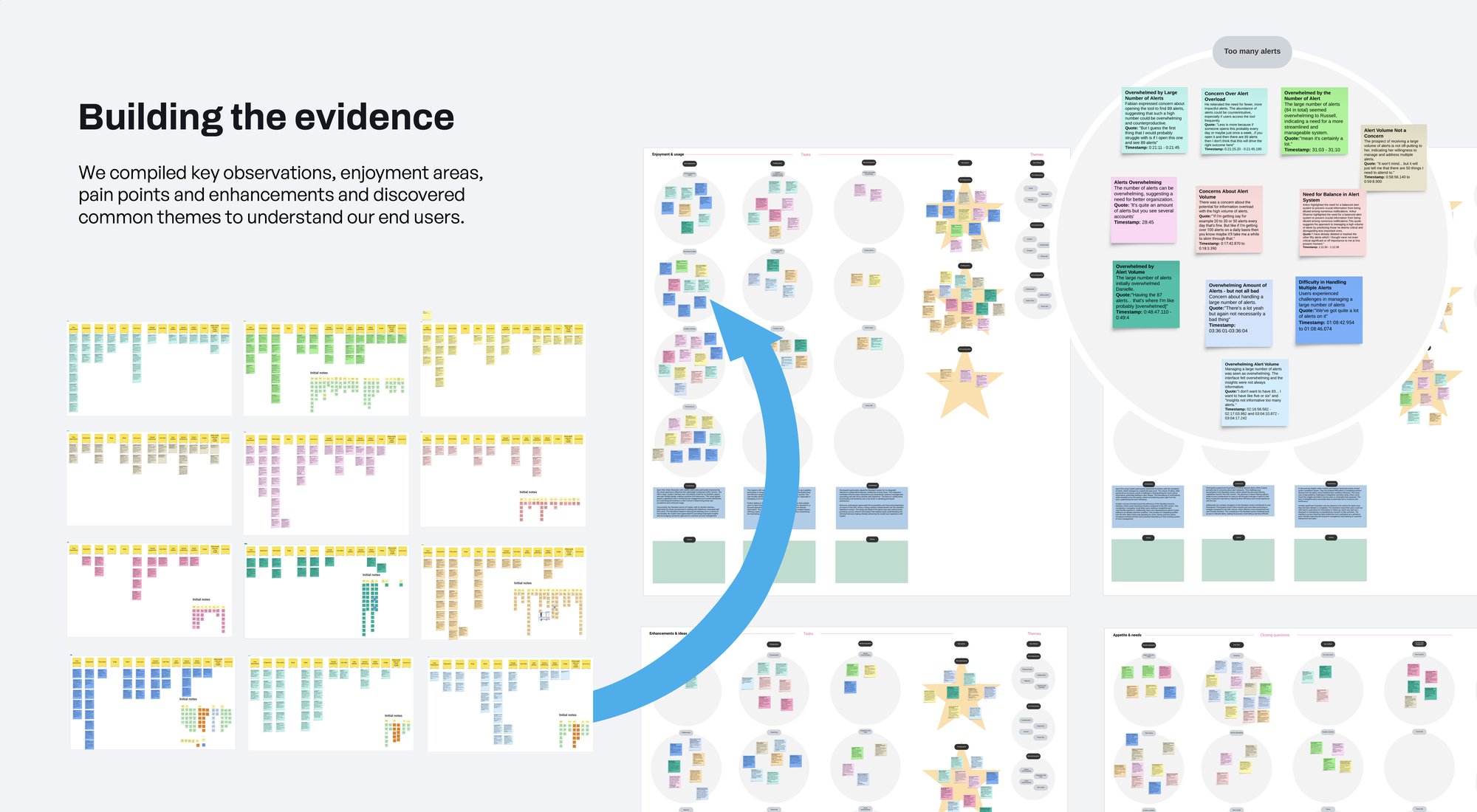
Affinity mapping and synthesis of research findings used to identify behavioural patterns, operational pain points and opportunity areas that informed the future-state experience.
Mapping the ecosystem
Design the service before designing the screens. What this chapter removed: uncertainty about how alerts should behave across the end-to-end service.
Before designing a single interface, I mapped how alerts moved through the organisation, tracing more than thirty operational alert types across multiple systems, user roles and business processes. This exposed where information originated, how it flowed between teams, and where users experienced unnecessary complexity.
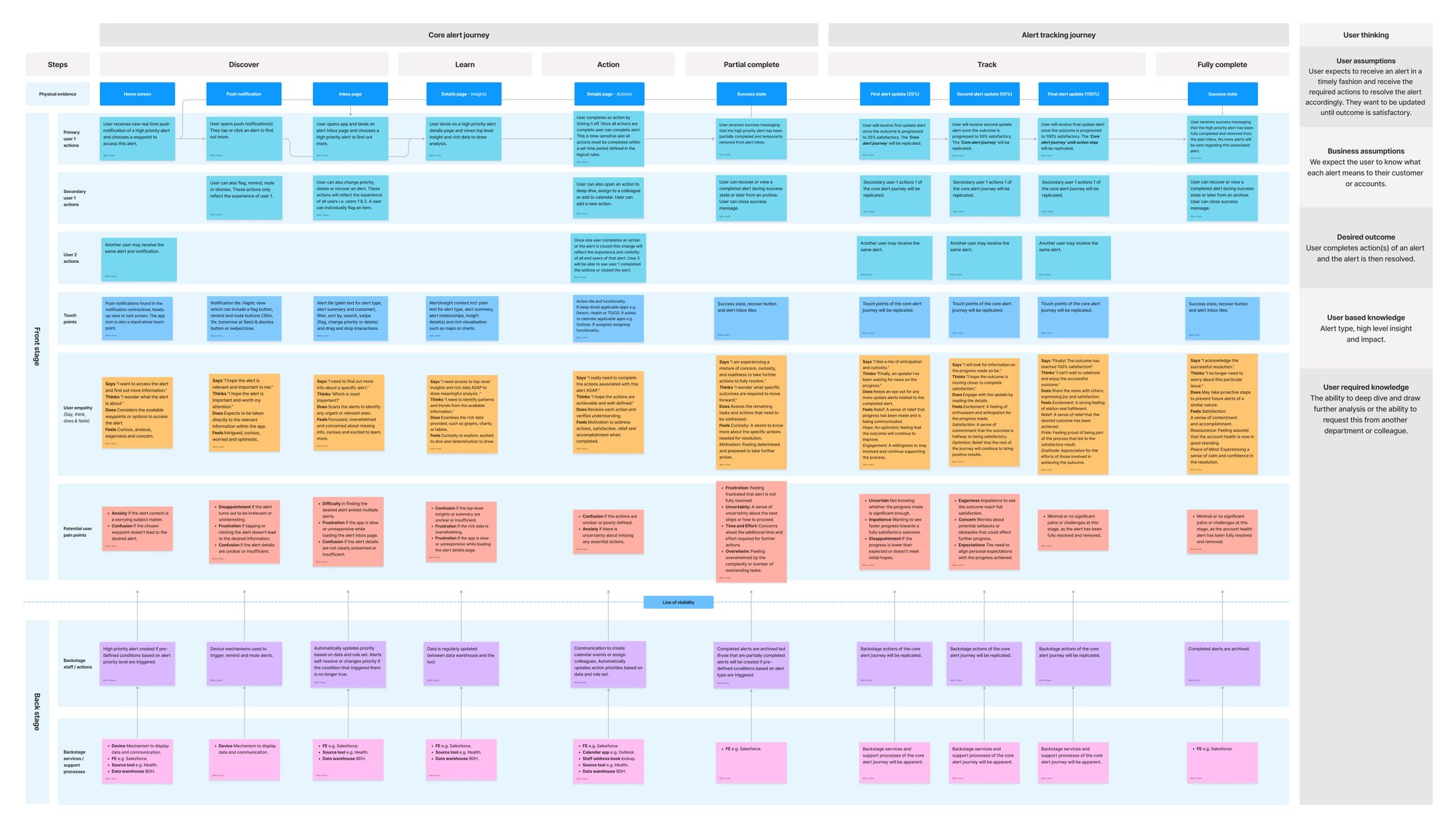
Rather than optimising individual screens, I designed the future-state service itself. The work established a scalable service architecture covering both time-sensitive and non-time-sensitive alerts, defining consistent behaviours, decision points, backstage processes, operational responsibilities and user journeys before interface design began.
Just because the organisation could generate an alert didn’t mean the user should receive it.
“I would struggle to work through 89 alerts… that would just not happen.”
These service blueprints became the shared reference for Product, Engineering and Design, aligning everyone around how the service should work before deciding how it should look.
Time sensitivity & priority
One of the most significant discoveries from the research was that the problem wasn’t simply the number of alerts users received.
The real challenge was understanding which alerts genuinely required attention, when they required action, and what users were expected to do next.
I developed a future-state alert strategy covering both time-sensitive and non-time-sensitive alerts, establishing a consistent relationship between urgency, priority and user behaviour before any interface design began.
These principles became the foundation for the alert lifecycle, prioritisation framework and future-state service blueprint.
Explore the Alert Lifecycle Framework
Supporting documentation from the service design programme.
Service Blueprint Highlights
- Future-state service blueprint covering time-sensitive alerts.
- Defined frontstage interactions, backstage processes and operational responsibilities.
- Standardised the alert lifecycle across multiple enterprise systems.
- Identified service gaps, operational pain points and opportunities before engineering investment.
- Established reusable service patterns that informed every subsequent interface.
That principle became the foundation for every design decision that followed.
Validating the concept
Validate the concept early. What this chapter removed: uncertainty about whether the concept itself was right.
Before any engineering investment, I tested an interactive prototype through moderated sessions combining an in-person usability lab with remote research across every other region.
The goal was never to validate an interface. It was to find out whether people trusted the concept.
“Everything is in a snapshot and it will be like a bird’s-eye view.”
“To me it’s perfect because it’s short, sweet, straight to the point. I don’t want to click into every notification. So for me it tells me exactly what it is, for who, what it is, what the problem is. So straight away I can see.”
People needed to understand the logic behind prioritisation and genuinely feel it reduced their effort, evidence that shaped the next iteration well before any code was written.
Moderated user research: understanding user appetite and needs for one centralised system, through moderated research combining an in-person usability lab and remote research.
In-person usability testing
I planned, built and ran the organisation’s first in-person and remote usability testing programme: recruitment, prototype design, facilitation and interviewing, through to observation, synthesis and feeding findings directly back into product design.
Remote user research
Remote moderated research sessions used to validate concepts with participants across multiple regions, enabling rapid feedback and iterative refinement throughout the design process.
Designing the decision model
What this chapter removed: uncertainty about how competing priorities should actually be resolved.
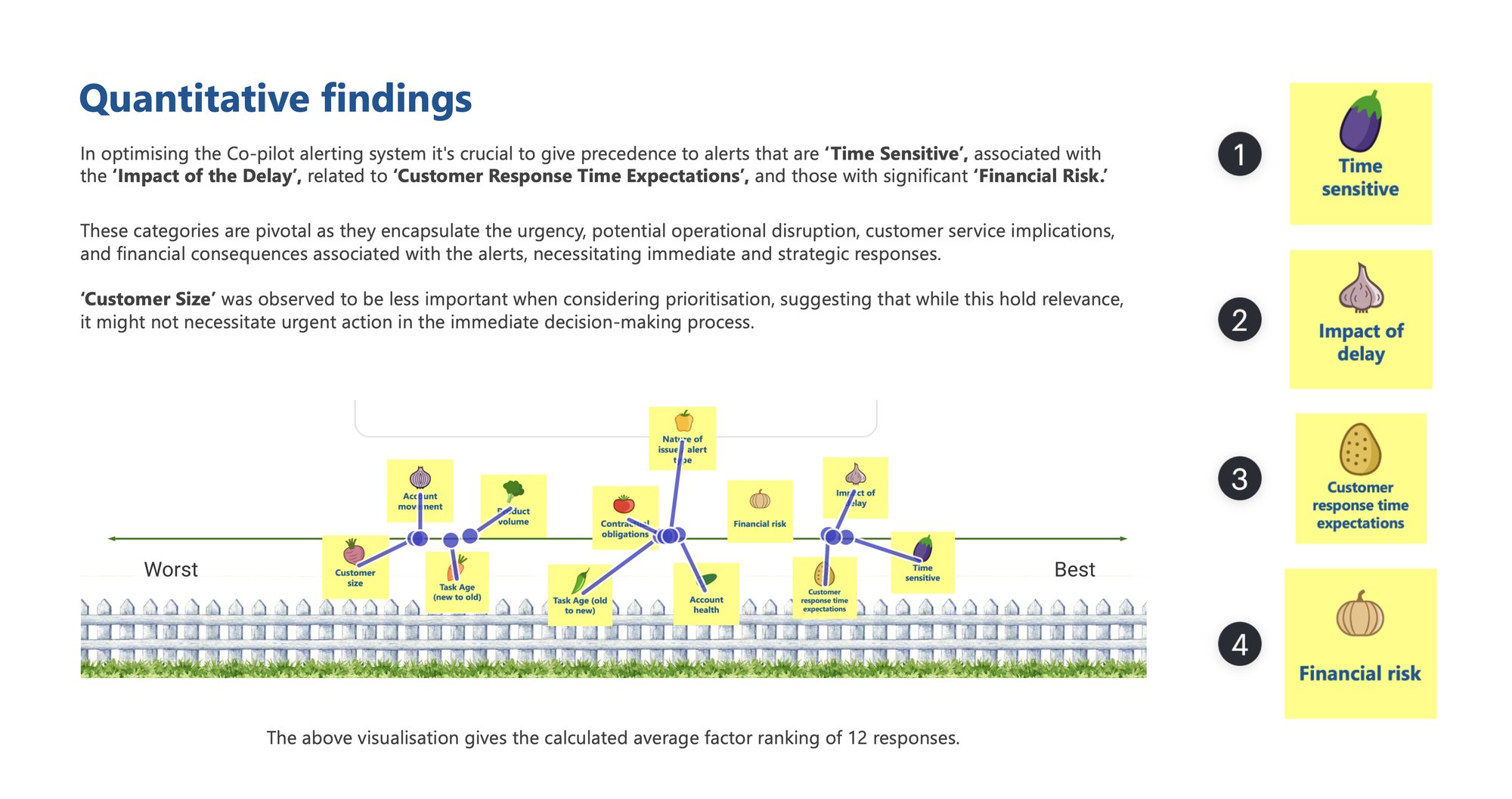
One question remained unanswered: when several things demanded attention at once, what should the system decide to surface first? Rather than answer that ourselves, we built a dedicated prioritisation research programme: workshops that surfaced how people reasoned about urgency, risk, customer impact and effort, followed by a survey that validated those patterns at scale.
The result wasn’t another interface. It was an evidence-based decision model.
“Maybe if you’re the manager and you see this is a high priority alert, you can assign a task to your people?”
That model became the logic behind the prioritisation engine built into the Proof of Concept. It also surfaced genuine regional variation, which emerged through the workshops and survey rather than any visual test: some markets weighted customer size more heavily, others weighted contractual risk. That evidence directly shaped how a future version of the model could adapt by region and role, rather than forcing one rule onto everyone.
Prioritisation workshops
I planned and facilitated cross-functional prioritisation workshops around user needs, operational value and business priorities.
The outputs from these workshops helped define the requirements that ultimately informed the prioritisation algorithm and future alert strategy.
Cross-functional prioritisation workshops helping define the requirements for the future prioritisation algorithm.
Engineering confidence
Validate the engineering approach. What this chapter removed: uncertainty about how the concept should actually be built.
Only once the concept itself was validated did the programme move into coded Proofs of Concept. Partnering with an external engineering team, I translated the UX direction into working builds across four platforms, never intended as production software, but as a way to test implementation approaches before committing internal engineering investment.
Multiple coded concepts were evaluated. People consistently preferred the standalone mobile experience, but the evidence told a different story: most worked primarily from laptops, many had no company-issued phone, and a separate app would likely go unused.
“I find it really interesting that it’s in the same system as we already use…”
It wasn’t the most exciting option. It was the option most likely to succeed.
That recommendation is the clearest evidence of the whole programme’s purpose: judgement, grounded in evidence, over personal preference.
Validating coded proof of concepts: customer feedback on usability, desirability and operational fit before engineering investment.
Outcome
The programme succeeded, not by shipping software, but by removing the uncertainty that would have made shipping software a gamble.
What it delivered was a validated product direction, a prioritisation model grounded in evidence, future-state service blueprints, functional product requirements, working Proofs of Concept and, most importantly, executive confidence grounded in global evidence rather than assumption.
View in more detail: Using research & data to drive design (PDF) →
From uncertainty to product direction.
The programme concluded with a concept film that brought together months of research, prioritisation and validation into a single vision for stakeholders. Rather than presenting isolated features, it demonstrated how evidence had shaped every aspect of the proposed experience.
A footnote on the name: this programme began life as “Digital Co-Pilot” — before Microsoft's Copilot existed, as it happens. When the naming collision became unavoidable, I led the rebrand to Nexa, shaping the new name and identity alongside the product work above.
Concept reveal video: executive vision demonstrating the validated product direction, interaction model and prioritisation approach.
What this demonstrates
Good discovery doesn’t prove an idea right. It gives an organisation enough evidence to make a confident decision, whatever that decision turns out to be.
The programme began by understanding fragmented information and decision-making. Only later did intelligent assistance emerge as one possible capability within the validated direction, never the reason the work existed.
The greatest value here was never the interface. It was turning ambiguity into a decision an organisation could actually commit to.
That’s the work of a Principal Product Designer: strategic judgement, systems thinking and the discipline to recommend what will actually succeed, not simply what’s most exciting to build.
See the same discipline applied at a different scale.