
Bringing the in-store sleep experience to every channel.
A programme for Bensons for Beds: translating a rich, staff-led showroom journey — comfort consultation, the sleeppro® fitting, body-shape capture and confident cross-sell — into an online experience that can diagnose and upsell just as well as a person on the shop floor.
The TV advert. “Your Bed, Your Way” introduced the promise of a fully personalised sleep experience — but that promise only existed in store and on the phone. Online, it was missing entirely. Closing that gap was the challenge this project set out to solve.
Project snapshot
The challenge, in short
In store, a colleague can hand someone a pillow, watch them lie down on a sleeppro®, and read a body shape in seconds — a diagnosis that naturally extends into a confident cross-sell, headboard, then the rest of the bedroom. Move that online and none of it travels: no conversation, no physical trial, and most shoppers don’t even realise a headboard isn’t included with a divan. The job was to get the online experience asking the same questions and reaching the same confident recommendation, without any of the showroom’s physical tools.
The tools in a customer’s hands don’t travel between channels. The diagnosis they produce has to.
My role, in short
I led the UX for “Your Bed, Your Way,” translating an in-store, staff-led sleep diagnosis into an online journey that could still do its job. Tap a tile for the fuller picture.
What I worked on
Shop-Floor Research
Watched how store colleagues actually ran the conversation — the comfort chat, the sleeppro® fitting, the cross-sell into headboards and bedroom furniture — and documented the journey directly from store colleagues and their training material.
Diagnosis & Questionnaire Design
A questionnaire-led route to the right mattress and pillow, built to ask the same questions and reach the same confident recommendation a colleague would in person — with a results summary customers can email or print to take away.
Build-Your-Bed Flow
Once comfort needs were covered, the flow moved on to style — colour, fabric, headboards and bedroom furniture — echoing how a colleague would guide that conversation face to face.
In-Store Experience Improvement
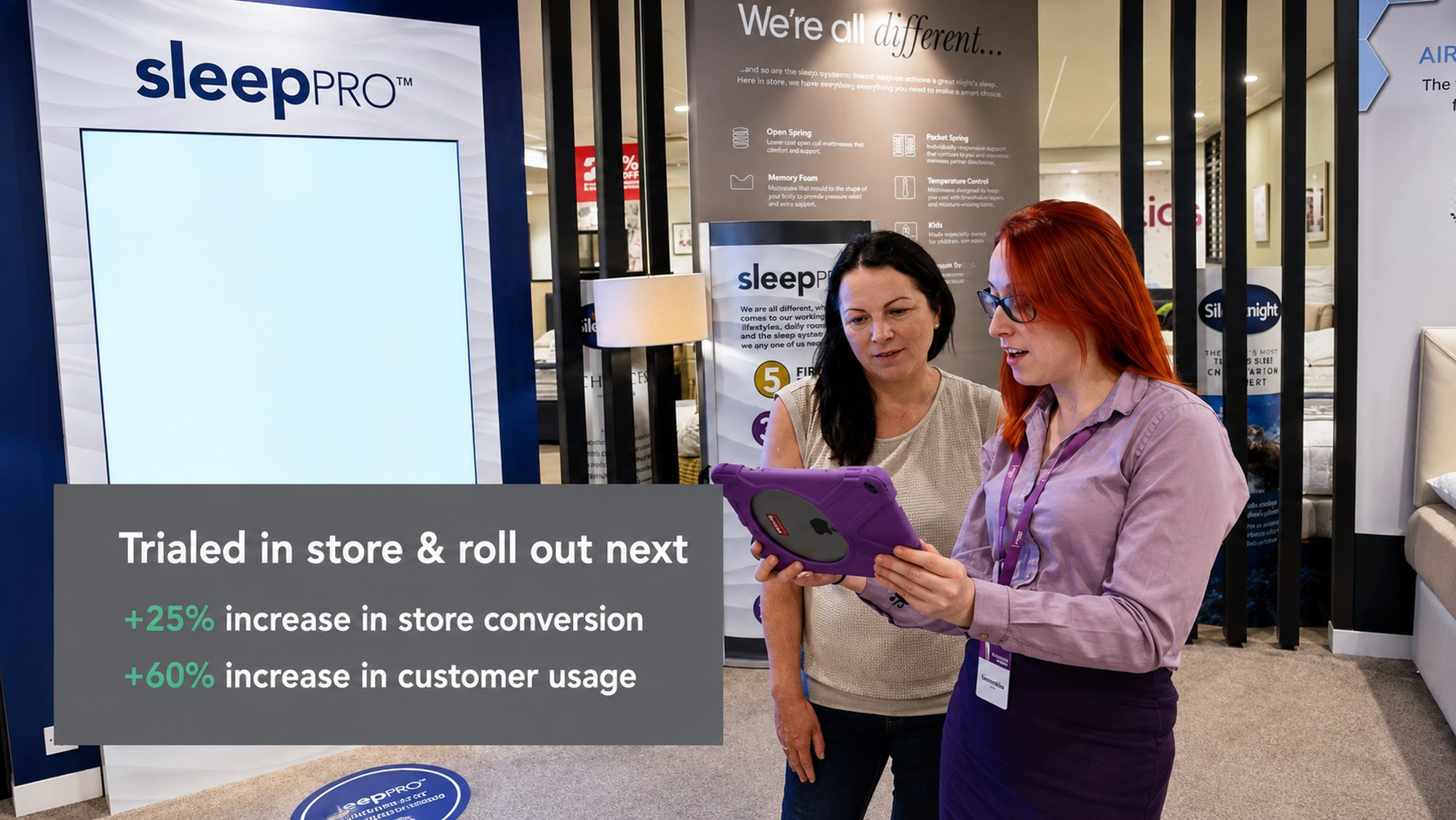
Not a one-way translation — the online research loop improved the in-store tool too. I redesigned the flow inside the third-party scanning software that powers sleeppro®, contributing to a 25% increase in store conversion and a 60% increase in customer usage.
The team
Lead DesignerMark Jones
Set the direction throughout — research, diagnosis design, the build-your-bed flow, and the improvements fed back into the physical sleeppro® tool.
Scanning Software Partner
Worked with their platform directly, redesigning the flow their scanning tool put in front of store colleagues and customers.
Store Staff
Spent time with store staff who ran the comfort conversation daily, learning how the diagnosis actually worked in practice before designing its online equivalent.
Engineering
Worked closely with engineering to get the questionnaire-led finder and build-your-bed flow live.
Ecommerce Manager
The nearest thing to a product owner on this project — closely involved in reviewing output and direction, with final sign-off, while I led the design decisions.
Impact, in short
Trialled in store and then rolled out, the redesigned sleeppro® experience delivered a 25% increase in store conversion and a 60% increase in customer usage. The build-your-bed flow and questionnaire-led finder brought that same diagnosis onto the web, with a results summary customers can email or print to take away. Whichever channel a shopper chooses for a bed — one of the biggest purchases they’ll make for their home — the diagnosis, the guidance and the reassurance now travel with them.
My role
I led the UX for “Your Bed, Your Way,” translating an in-store, staff-led sleep diagnosis into an online journey that could still do its job.
The challenge
A colleague in store can hand over a pillow, watch someone lie down on a sleeppro®, and read a body shape in seconds. None of that travels onto a screen. The job was to get the online experience asking the same questions, and reaching the same confident recommendation, without any of the physical tools a showroom takes for granted.
I spent time on the shop floor watching how store colleagues actually ran the conversation — the comfort chat, the sleeppro® fitting, the cross-sell into headboards and bedroom furniture. From there I designed the equivalent online experience: a guided, questionnaire-led route to the right mattress and pillow, and a build-your-bed flow that mirrors the in-store upsell. I also fed what I learned back into improving the in-store sleeppro® experience itself.
Contributions
Led personally throughout, with a light supporting cast — a scanning-software partner, store staff, engineering and an ecommerce manager signing off direction. Here’s the honest breakdown — tap a tile for the fuller picture.
What I worked on
Shop-Floor Research
Watched how store colleagues actually ran the conversation — the comfort chat, the sleeppro® fitting, the cross-sell into headboards and bedroom furniture — and documented the journey directly from store colleagues and their training material.
Diagnosis & Questionnaire Design
A questionnaire-led route to the right mattress and pillow, built to ask the same questions and reach the same confident recommendation a colleague would in person — with a results summary customers can email or print to take away.
Build-Your-Bed Flow
Once comfort needs were covered, the flow moved on to style — colour, fabric, headboards and bedroom furniture — echoing how a colleague would guide that conversation face to face.
In-Store Experience Improvement
Not a one-way translation — the online research loop improved the in-store tool too. I redesigned the flow inside the third-party scanning software that powers sleeppro®, contributing to a 25% increase in store conversion and a 60% increase in customer usage.
The team
Lead DesignerMark Jones
Set the direction throughout — research, diagnosis design, the build-your-bed flow, and the improvements fed back into the physical sleeppro® tool.
Scanning Software Partner
Worked with their platform directly, redesigning the flow their scanning tool put in front of store colleagues and customers.
Store Staff
Spent time with store staff who ran the comfort conversation daily, learning how the diagnosis actually worked in practice before designing its online equivalent.
Engineering
Worked closely with engineering to get the questionnaire-led finder and build-your-bed flow live.
Ecommerce Manager
The nearest thing to a product owner on this project — closely involved in reviewing output and direction, with final sign-off, while I led the design decisions.
A showroom experience that doesn’t travel.
In store, a good colleague turns a mattress sale into a diagnosis, and a diagnosis into a bigger basket. Move that same customer online, and most of that disappears.
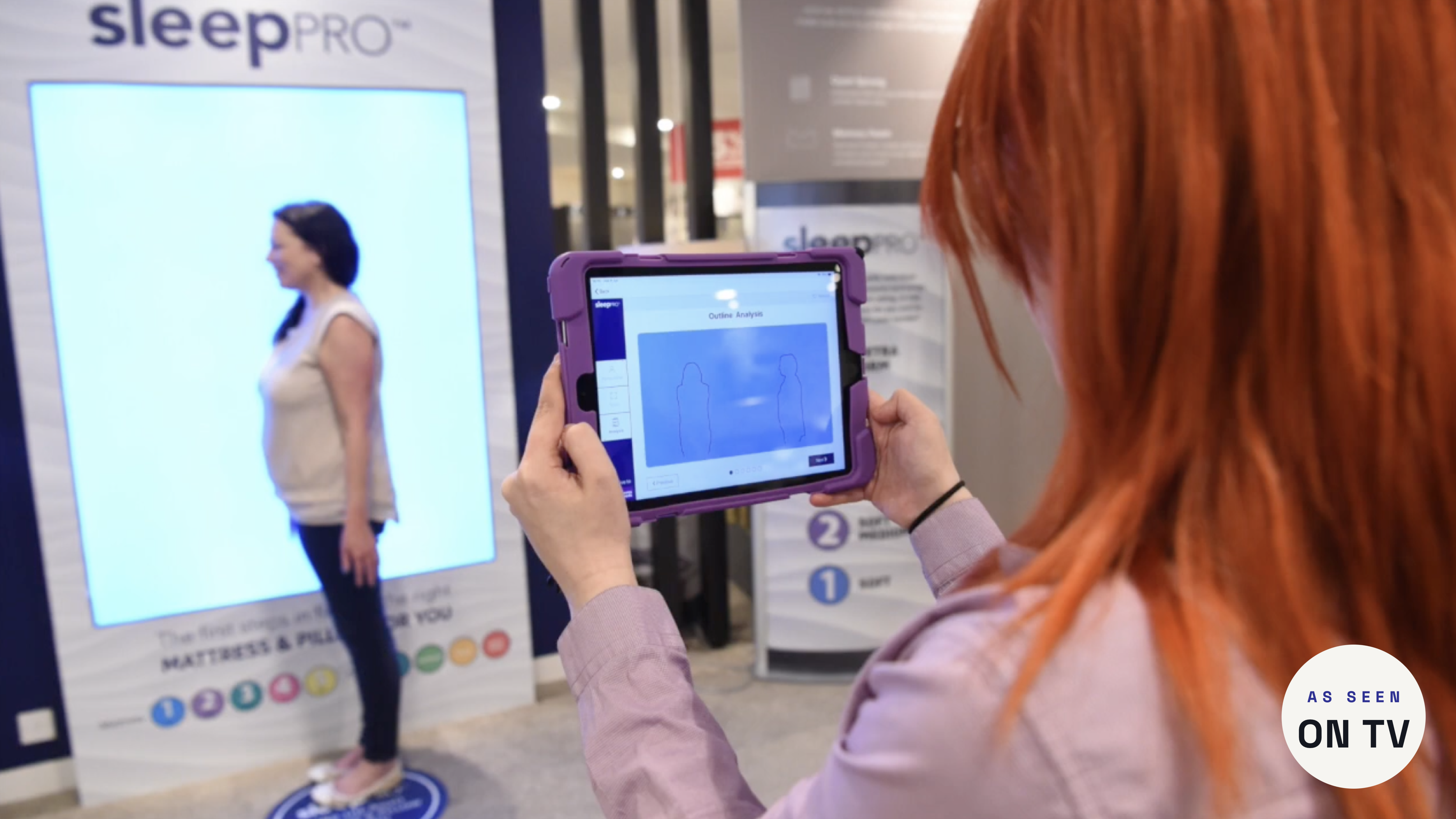
In a Bensons for Beds showroom, the journey is led by a person: a colleague talks through comfort preferences, hands over a pillow to get a feel for support, and walks the customer to the sleeppro®, where they lie down and are guided through a proper fitting. Alternatively during trial, an iPad captures body shape to help judge the right mattress type, but also the right pillow type, comfort and size. From there, the conversation naturally extends — if it’s a divan, what about a headboard? What about the rest of the bedroom?
Online, hardest of all: there’s no conversation at all, so nothing prompts the cross-sell and nothing replaces the physical trial. Most online users do not even know that a headboard is not included with a divan bed purchase.
The tools in a customer’s hands don’t travel between channels. The diagnosis they produce has to.
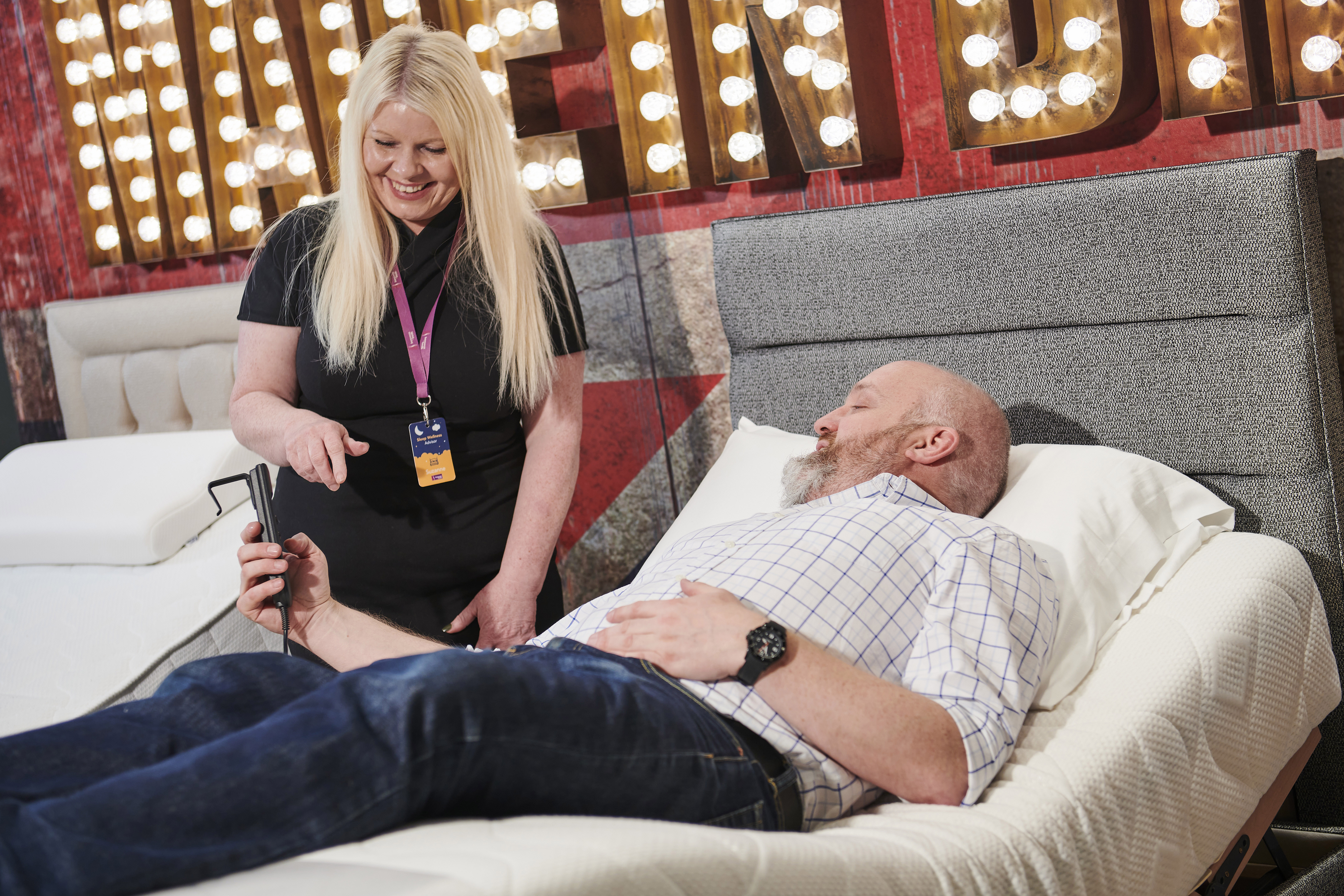
The comfort conversation: understanding how someone sleeps before recommending anything.
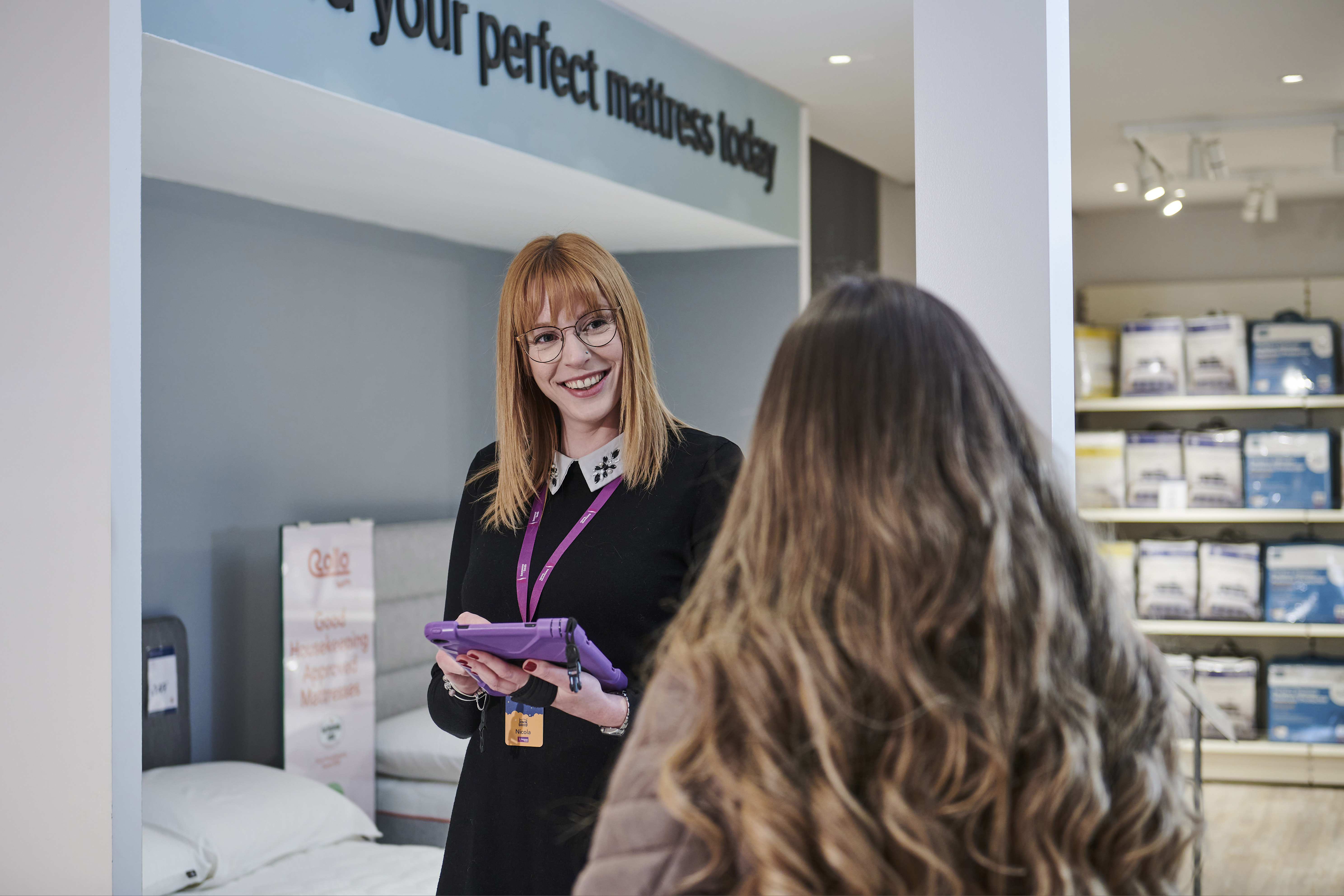
The tablet-led consultation, used to guide the conversation and record the customer’s answers.
Watching the showroom floor.
Before designing anything, I needed to see exactly what a good in-store conversation does — and where online quietly falls short of it.
I spent time observing store colleagues running the comfort consultation and sleeppro® fitting end to end, then mapped that against the online journey. This made it clear which parts of the in-store experience were about the physical tools (the pillow, the sleeppro® bed itself) and which were really about the underlying diagnosis — sleep position, firmness, body shape, budget — that online could ask for too, given the right prompts. Once comfort needs are covered, store staff move on to style: colour, fabric and the aesthetic a customer has in mind, matching that against what will actually fit their bedroom.
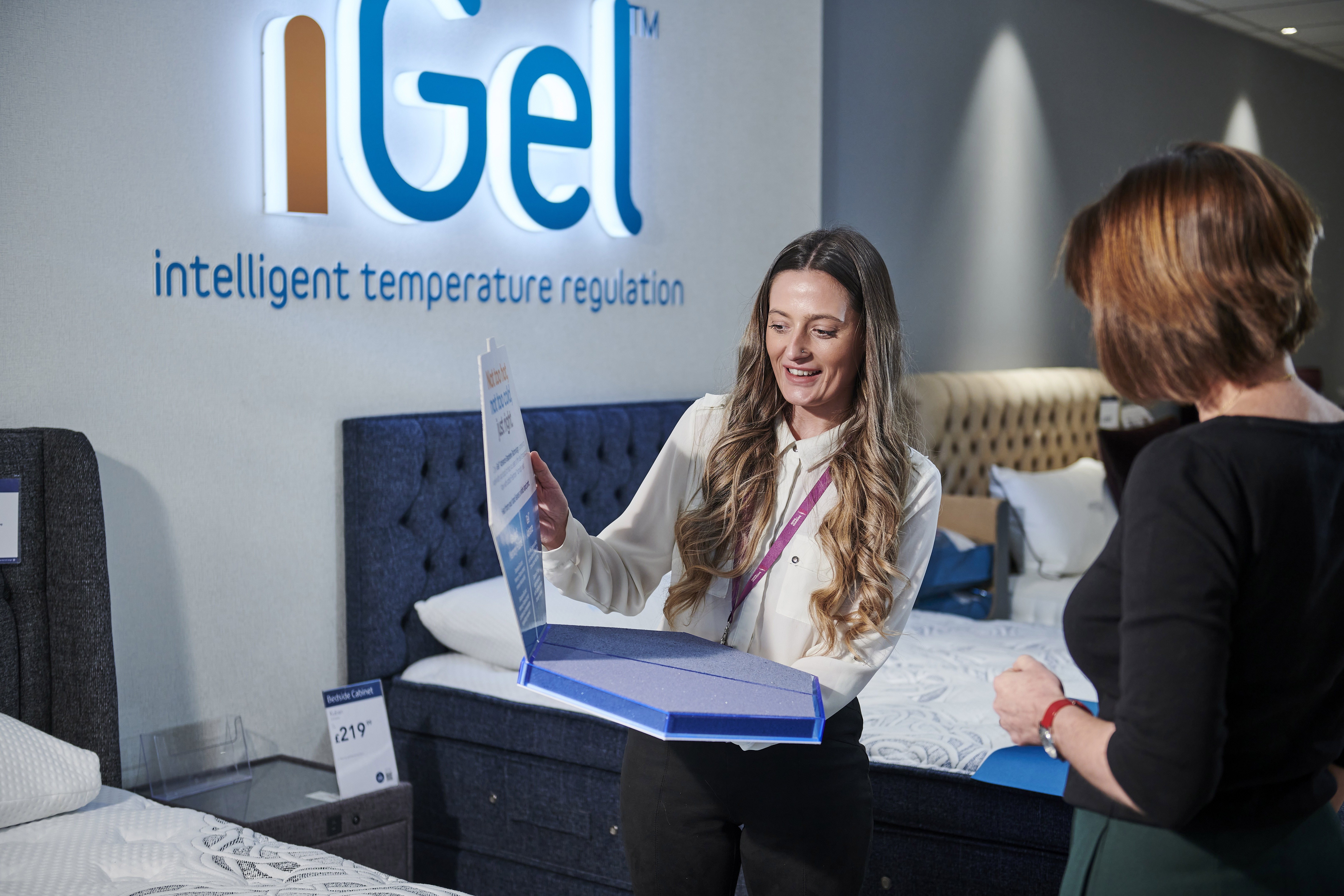
A colleague talking a customer through the iGel range — here, discussing colour options alongside the bed’s temperature-regulation technology, the kind of hands-on, technical demonstration that’s hardest to replicate outside the showroom.
- ✓Guided comfort conversation with a colleague
- ✓Physical sleeppro® fitting and pillow trial
- ✓iPad body-shape capture
- ✓Natural, colleague-led cross-sell
- ✕No conversation at all, unless one is designed in
- ✕No physical sleeppro® fitting or pillow trial
- ✕No body-shape capture, unless one is designed in
- ✕No prompted cross-sell, unless one is designed in
- ✓Guided comfort conversation with a colleague
- ✕No physical sleeppro® fitting or pillow trial
- ✕No body-shape capture
- !Cross-sell relies on the colleague remembering to ask
The 16-step store conversation.
The store flow below is the CSA (Comfort Station Adaptive) journey I documented directly from store colleagues and their training material, originally mapped in 2017. Its structure held up remarkably well: step 1, the “Comfort Station” introduction, is exactly the conversation that later became sleeppro® when it launched in 2021 — the underlying script barely changed, only the tool behind it did.
The service blueprints behind it.
Alongside the store conversation, I mapped the current-state service blueprints for the store and online channels — the front and back-of-house steps, systems and handoffs behind each one.
The tools couldn’t travel. The questions behind them could.
Building the bed online, piece by piece.
The in-store upsell — mattress, then headboard, then the rest of the bedroom — became a build-your-bed flow that online customers go through themselves.
In store, cross-sell happens naturally in conversation: a customer chooses a divan base and mattress, and the colleague asks about a headboard, then bedroom furniture to match. Online, I designed that same sequence as a guided build — base and mattress first, then headboard, then complementary furniture — using the customer’s own selections to suggest what fits, rather than relying on a person to ask.
The bed configurator, online and on mobile. Build your bed, then the guided upsell and cross-sell into headboards and furniture — the same sequence a store colleague would walk you through.
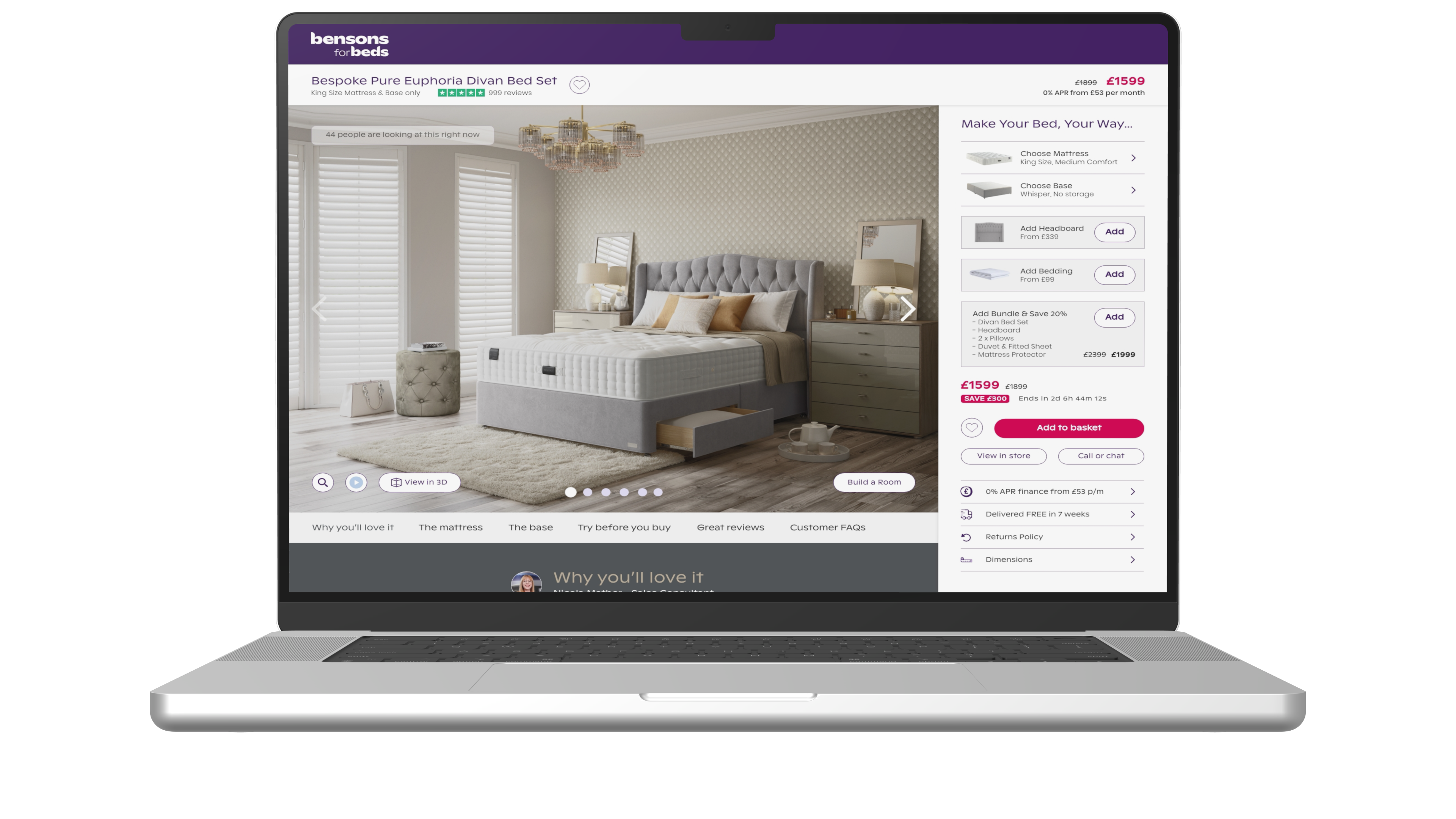
The desktop product page: “Make Your Bed, Your Way” runs the same choose-mattress, choose-base, add-headboard, add-bedding sequence as the in-store cross-sell — plus a bundle discount to make saying yes easier.
Adding a headboard: the customer sees it styled on their exact bed, in real time, as they choose a colour — the same cross-sell moment a colleague would prompt in store.
The product page carries the same depth a colleague would offer face to face: a Sleep Expert video, guarantee and certification detail, a layer-by-layer material breakdown, and a cross-sell into matching pillows.
A human touch is never more than a tap away: live chat and an AR “see it in your space” view sit on the product page itself, and the store finder lets a customer video-call their nearest showroom directly. Video chat and a virtual store walkaround, introduced during COVID, stayed on afterwards — a channel of its own now, not a stopgap.
Grounding it against Dreams and IKEA.
Alongside the store observation, I planned, facilitated and synthesised a remote research study to pressure-test what the new product page and “Your Bed, Your Way” experience needed to get right. Ten users — five on desktop, five on mobile, all either shopping for a bed or having recently bought one — card-sorted the components of a product page by importance, then talked through the Bensons, Dreams and IKEA product pages side by side, focusing on what a divan actually includes, and how finance, social proof and upselling should be handled.
Imagery, dimensions and what’s actually included with a divan came out as the biggest gaps for Bensons specifically — not new problems, but ones this research made concrete enough to design against, directly shaping the build-your-bed flow above: mattress feel and firmness first, dimensions shown at every step, and cross-sell offered rather than pre-ticked.
Users wanted range, 360° views and video at the forefront — not buried below the fold.
Shoppers needed size shown against the image itself, not just listed as numbers.
Divan confusion was universal — base, mattress and headboard need to be stated up front.
Cost, timing and the 40-night guarantee all needed to sit near the price, not in T&Cs.
Firmness guidance and richer feature content were dealbreakers, not nice-to-haves.
“Frequently bought together” read as pushy and pre-ticked — upsell needed to feel optional.
sleeppro®: the science behind the fitting.
Finding the right mattress and pillow isn’t one question, it’s several — and sleeppro® asks all of them in store. My job was bringing that same diagnosis online.
The sleeppro® fitting works through a set of factors together, not in isolation: how someone sleeps, who they share the bed with, their body shape, and any orthopedic or back considerations, all pointing towards a firmness rating from soft through to extra-firm. Pillow fit follows the same logic — head width and shoulder shape determine what actually supports someone properly. I designed an online questionnaire that walks through the same dimensions, so a customer with no colleague and no sleeppro® in front of them still ends up at the right recommendation. The same thinking fed back into improving the in-store sleeppro® experience itself.
Side, back or front sleeper — the starting point for firmness and support.
Shared movement and different body types change what a mattress needs to do.
Weight distribution affects how much support and give is needed, and where.
Soft, medium, firm or extra-firm — the output of everything else combined.
Back problems and similar issues that steer the recommendation further.
Head width and shoulder shape determine the right pillow, not just preference.




The four comfort ratings — soft through extra-firm — that every sleeppro® fitting, in store or online, resolves to.
The sleeppro® station: the customer lies down, and BodiTrak pressure-mapping technology reads how they sleep and where they need support.
Sketching the mattress finder.
Before any of this was built, I paper-sketched the finder end to end: choosing a category, a sleep-position survey, a size picker, a symptoms screen with combinable options, and a results feed with a personalised, algorithm-matched list — through to a single product page and buy.
Early paper concepts for the online mattress finder — working out the questions, the survey logic, and how a personalised result would be shown before a line of it was built.
The online equivalent, without a sleeppro® to lie on: a “Find your dream bed” questionnaire that walks through size and comfort rating — soft through extra-firm — step by step.
The sleep survey flow.
These are the wireframes I drew up for the online sleep quiz concept — each step aligned to the same questions sleeppro® asks in store: mattress feel, sleep position, aches and pains, temperature, and whether a partner moves around at night, before landing on a shortlist of matched mattresses.
Continuously improving ways to find a comfort rating.
The first edition of sleeppro® was that the comfort rating came from a pressure-sensor mattress tester built into a store fixture: a customer lies down, and the display maps live pressure points across the body against a soft-to-extra-firm scale. This is currently in use today. sleeppro® replaced the fixed fixture with an iPad workflow for a trial exploration — personalise, scan, analyse, results — that a colleague could carry anywhere on the shop floor, run a body-shape scan from, and still land on the same four-point comfort rating.
The original mattress tester: a fixed fixture reading live pressure points to determine a comfort rating.
sleeppro®’s iPad workflow: a body-shape scan a colleague can run anywhere in store.
The personalise step: the same diagnostic questions a colleague would ask, captured on-screen.
Optimising the interface.
The first version of the scan UI, built by the technology supplier, had too many steps and too little signposting — in-store testing showed colleagues struggling to get customers through it. I sketched alternative flows, built a rapid screen prototype, and tested it with colleagues who hadn’t used the original, iterating until the steps and navigation held up on the shop floor.
The optimised UI: a clear single/couple choice and a visible four-step journey.
The problem in the original: a noisy, unreadable capture screen with no clear next step.
In store: the scan running end to end, colleague-led, in front of the customer.
The results: trialled in store, then rolled out — +25% store conversion, +60% customer usage.
Optimising pillow customisation.
The optimised analysis screen for pillow fit: head width and shoulder width read straight off the scan, resolving to a size group.
Sleeping alone, or with a partner.
Whether someone sleeps alone or shares a bed changes the comfort rating they need, sometimes down to the extra weight and the different sleep positions — side, front, back — each person brings. Some mattresses can even offer two different comfort ratings across one bed, so a couple isn’t forced to compromise on one rating for both.
The second screen is more delicate: it’s from an early version of the body scan, used to determine body mass and shape. Lying on a mattress to have pressure points read is personal enough in front of a store assistant and a busy shop floor; a body scan raised real concerns about privacy and being seen. Overall, the body-scan experience wasn’t well received by customers — but the people who did use it found the right mattress and pillow, so it stayed as an optional route rather than the default.
Choosing single or couple: the starting point for a shared-bed comfort rating.
The early body-scan analysis: posture, mass and shape. Useful when customers used it, but not universally well received.
Sleep position, reducers and discomforts.
The personalise flow builds up a picture one card at a time: name, gender, then sleep position — back, side, tummy, or various — each completed step turning green and collapsing to a single line so the customer can see how far through they are. Sleep reducers come next (too firm, too soft, too hot, too cold, allergies, sleep apnoea, or none), followed by sleep discomforts mapped to the body — neck, shoulders, upper back, lower back, hips, legs — so aches and pains feed directly into the recommendation, not just preference.
Step 3: sleep position — back, side, tummy, or various.
Step 4: sleep reducers — the things that stop someone getting comfortable.
Step 5: sleep discomforts, mapped to the body — each completed step turns green as the picture builds.
The results summary.
Once personalise, scan and analysis are complete, everything collapses into one results summary — every answer given, alongside the recommendation it produced: mattress softness, springiness and pillow size, sized and named plainly rather than left as raw numbers. The customer can email it to themselves or print it to take away, so the diagnosis leaves the store with them.
One diagnosis. Multi channels, all capable of asking it properly.
A high-value purchase, shopped with the same confidence, in a showroom or on the sofa.
Whichever channel a customer chooses for a bed — one of the biggest, most considered purchases they’ll make for their home — the diagnosis, the guidance and the reassurance now travel with them.
See the same discipline applied elsewhere.